Laser Vision Correction

LASIK vs LASEK: How These Two Laser Vision Correction Procedures Differ

LASIK vs LASEK: How These Two Laser Vision Correction Procedures Differ

Among the laser vision correction options available in Singapore, LASIK vs LASEK are two of the most commonly considered. Both have been performed for more than two decades and remain in active clinical use, although they involve different surgical techniques and recovery profiles.

The right procedure for any individual is determined by an eye specialist after a clinical assessment that evaluates corneal anatomy, refractive error, ocular surface health, and lifestyle considerations.

What Is LASIK?

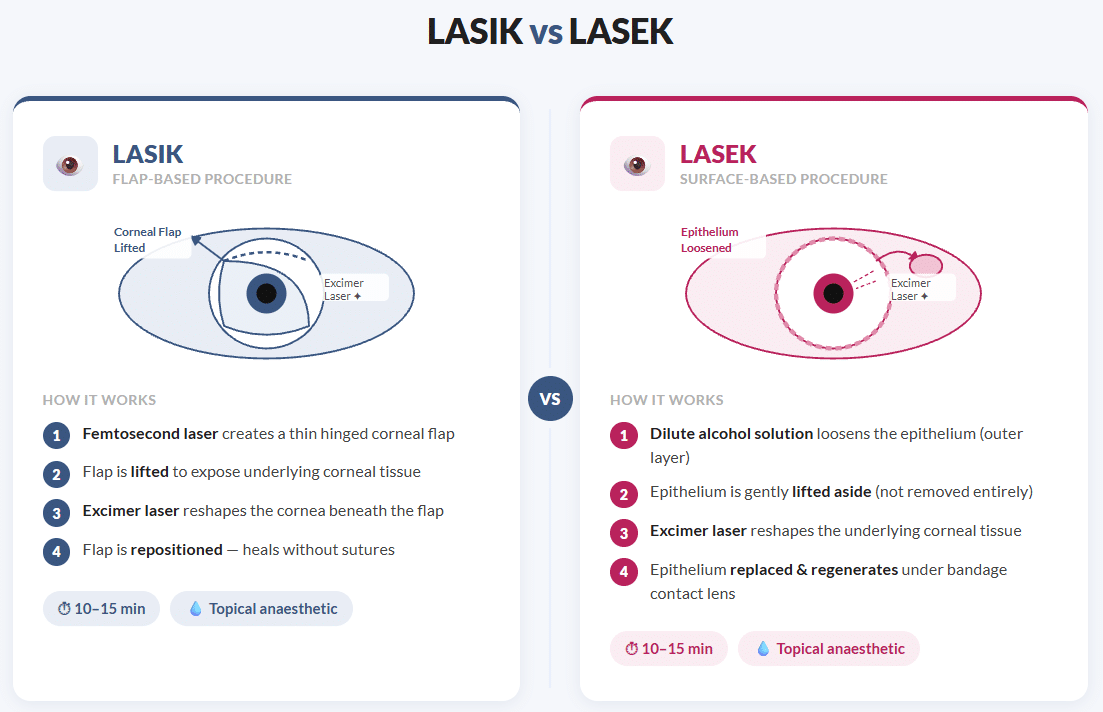
LASIK (Laser-Assisted In Situ Keratomileusis) is a flap-based laser vision correction procedure. The surgeon creates a thin corneal flap (a hinged layer of the outer cornea) using a femtosecond laser, lifts it to expose the underlying corneal tissue, and uses an excimer laser to reshape the cornea. The flap is then repositioned and allowed to heal without sutures.

The procedure typically takes around 10 to 15 minutes for both eyes under topical anaesthetic eye drops. Some pressure and altered vision are common during the laser application, with mild blurring and tearing in the hours immediately after surgery.

LASIK eye surgery is used to correct myopia (short-sightedness), hyperopia (long-sightedness), and astigmatism within defined refractive ranges.

What Is LASEK?

LASEK (Laser-Assisted Subepithelial Keratomileusis) is a surface-based laser vision correction procedure. The surgeon loosens the epithelium (the outermost layer of the cornea) with a dilute alcohol solution, lifts it aside, and uses an excimer laser to reshape the underlying corneal tissue.

The epithelial layer is then replaced and regenerates over the following days, typically supported by a bandage contact lens.

The procedure takes around 10 to 15 minutes for both eyes under topical anaesthetic. The early hours and days after surgery often involve more discomfort than LASIK, since the epithelium needs to heal back over the treated area.

LASEK eye surgery is one of several surface ablation procedures used to correct myopia, hyperopia, and astigmatism within defined refractive ranges.

Infographic Overview of how LASIK and LASEK Procedure differs

lasik vs lasek

How LASIK and LASEK Differ

LASIK and LASEK share the same goal of reshaping the cornea, although they differ in surgical technique, recovery experience, and suitable patient profiles.

1. Surgical Technique

LASIK creates a corneal flap that is lifted to expose the stromal tissue beneath, then repositioned after the laser reshaping is complete.

Meanwhile, LASEK works at the surface of the cornea, with the epithelial layer loosened and lifted aside rather than a deeper flap created.

2. Initial Visual Recovery

While LASIK typically allows functional vision recovery by the day after surgery, LASEK recovery is more gradual, since the epithelium regenerates over the treated area. Functional vision typically returns over three to five days, and visual stability continues to refine over the following weeks.

3. Discomfort During Recovery

LASIK patients generally experience mild discomfort, light sensitivity, and a foreign body sensation in the first 24 hours, which tend to resolve without intervention.

In contrast, LASEK patients may experience more pronounced discomfort during the first three to five days while the epithelium heals, often managed with prescribed eye drops and a bandage contact lens.

4. Clinical Considerations

LASIK requires sufficient corneal thickness to safely create the flap and leave an adequate residual stromal bed beneath.

However, LASEK does not involve a deeper flap and may be appropriate for patients with thinner corneas, certain ocular surface conditions, or lifestyles involving contact sports where flap-related considerations apply.

5 Key Considerations When Comparing LASIK vs LASEK

The choice between LASIK and LASEK is typically reviewed against a set of clinical and personal factors during the suitability assessment:

  1. Refractive error and prescription strength: The degree of myopia, hyperopia, and astigmatism the procedure needs to correct.
  2. Corneal thickness and shape: Measured through topography and tomography, which determine how much tissue can be safely reshaped.
  3. Dry eye history and ocular surface health: Tear film stability and ocular surface findings may influence which procedure is more appropriate.
  4. Lifestyle factors: Occupation, contact sports, and exposure to environments with a higher risk of eye trauma.
  5. Recovery preferences: Tolerance for a slower visual recovery and the time available away from work or screen use.

LASIK vs LASEK vs TRANS-PRK vs SMILE pro 2.0 vs SILK: Three Surgical Approaches Explained

Laser vision correction is performed through three broad surgical approaches:

  • Flap-based (LASIK)
  • Surface-based (LASEK and PRK)
  • Lenticule extraction (ZEISS SMILE® pro 2.0 and SILK)

PRK (Photorefractive Keratectomy) is the original surface-based ablation procedure. The surgeon removes the epithelium entirely before the excimer laser reshapes the underlying cornea, and the epithelium regenerates over the following days.

Meanwhile, lenticule extraction reshapes the cornea without creating a corneal flap. In this procedure, a femtosecond laser shapes a small lens-shaped piece of corneal tissue (a lenticule) within the cornea, which is then removed through a small incision typically of 2 to 4 millimetres.

ZEISS SMILE® pro 2.0 is the latest generation lenticule extraction procedure, performed on the ZEISS VISUMAX 800 femtosecond laser platform.

Meanwhile, SILK is a separate lenticule extraction procedure performed on a different femtosecond laser platform, available at clinics that operate that system.

While SILK and SMILE pro 2.0 share the broader lenticule extraction approach, they differ in the laser platform and lenticule design used in each procedure.

How to Decide Which Laser Vision Correction Procedure Is Right for You

No single laser vision correction procedure suits every patient. The choice is shaped by a combination of clinical and personal factors:

  1. Eye anatomy, such as corneal thickness, corneal shape, and pupil characteristics.
  2. Refractive error and prescription range.
  3. Dry eye history and ocular surface condition.
  4. Lifestyle and occupational considerations like contact sports and exposure to eye trauma risk.
  5. Recovery preferences and individual goals.

The Importance of a Personal Suitability Assessment

personal-suitability-assessment-cover-image

In the decision between LASIK vs LASEK vs ZEISS SMILE® pro 2.0 vs SILK vs TRANS-PRK, each option carries its techniques, pros, and cons.

As such, the most reliable way to identify which procedure may suit your eyes is through a clinical assessment that evaluates corneal anatomy, refractive error, ocular surface health, and individual lifestyle factors. An eye specialist can then review the findings and discuss appropriate procedures for your results.

If you are considering laser vision correction, book an eye assessment at LSC Eye Clinic, where our specialists can provide consultations on the full range of laser vision correction options, including LASIK, LASEK, PRK, TransPRK, and ZEISS SMILE® pro 2.0 in Singapore.

Citations & References:

Telephone Icon Call Us WhatsApp Calendar Icon Book Appointment