LASIK in Seoul vs Singapore: A Comparison Guide for Patients Weighing Their Options
Across Asia, more patients are exploring overseas options for elective medical procedures, and South Korea has become a destination of interest for laser vision correction.
For Singaporean patients weighing LASIK in Seoul vs Singapore, the factors that shape this decision sit in regulatory frameworks, the total cost once travel and follow-up are factored in, and the realities of continuity of care after the procedure.
Why Some Singaporeans Consider Korea for LASIK
LASIK medical tourism has grown across Asia over the past decade, with South Korea positioning itself as a destination for elective procedures, including aesthetic and ophthalmic surgery. Several factors commonly motivate patients to look beyond Singapore:
- Perceived cost differentials: Published Korean prices for standard LASIK often appear lower than local equivalents at first glance.
- Holiday and procedure combination: Some patients see overseas treatment as an opportunity to combine the experience with a trip.
- International visibility: Several Korean clinics market actively to overseas audiences, which raises their profile during online research.
Comparing LASIK Technology Available in Both Locations
Both Singapore and Korea operate within developed healthcare ecosystems with access to the latest laser platforms and technology, including ZEISS, Alcon, and other established manufacturers.
Procedural options, such as standard LASIK, ZEISS SMILE® pro 2.0, and surface ablation procedures like TransPRK, Epi-LASIK, and LASEK, are broadly similar across reputable clinics in both countries.
The variable that often differs is surgeon experience and how individual case suitability is assessed against the specific anatomy and clinical history of each patient.
Regulatory and Clinical Standards in Each Country
South Korea
LASIK in South Korea is regulated by the Ministry of Health and Welfare, with clinical standards for ophthalmic practice set by the Korean Ophthalmological Society. Surgeons must be licensed under national medical registration.
Singapore
LASIK in Singapore is regulated under the Healthcare Services Act (HCSA), administered by the Ministry of Health.
Refractive surgeons are required to be registered specialists with the Singapore Medical Council and to comply with the council’s Ethical Code and Ethical Guidelines. The HCSA framework governs clinical standards, advertising, and patient safety protocols.
Cost Considerations: LASIK Eye Surgery Cost in Seoul and Singapore
How Much Does LASIK Cost in Seoul
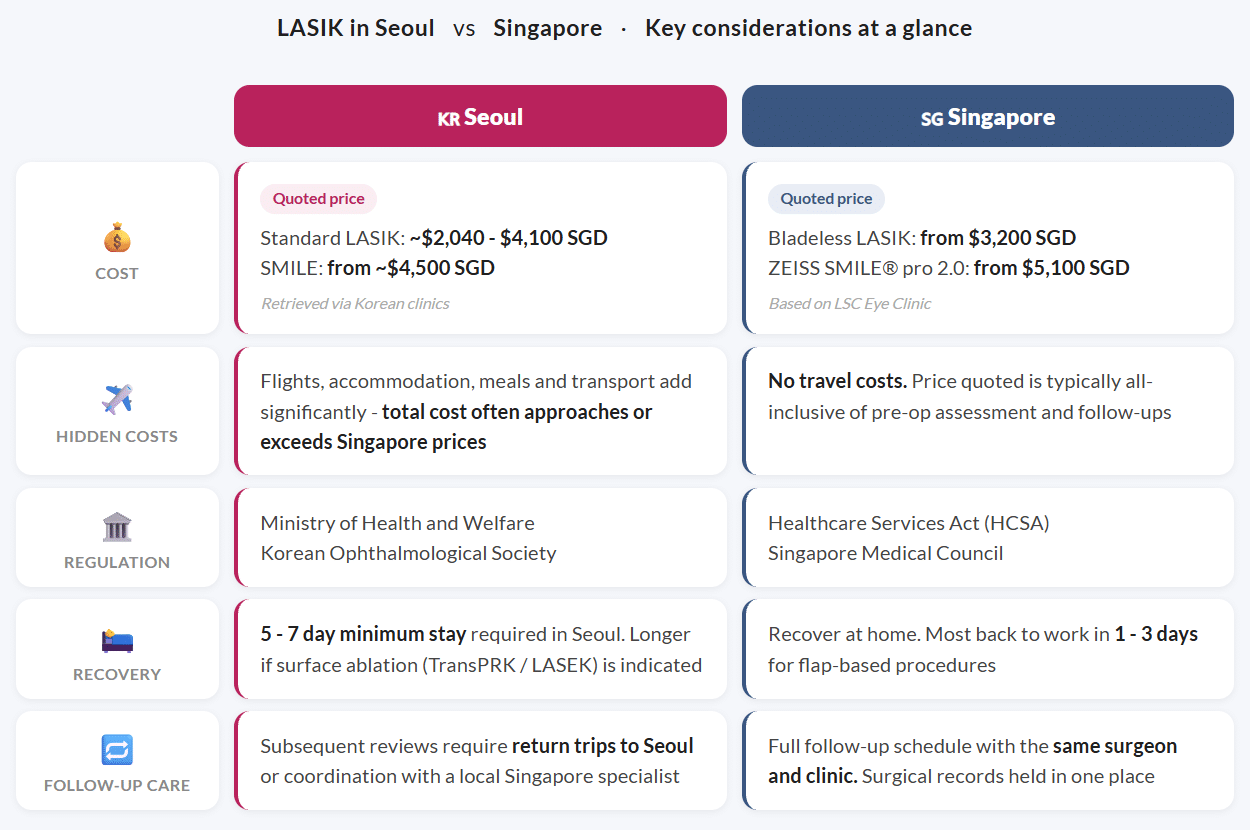
The cost of LASIK in Korea varies by procedure type and clinic. Quoted prices typically cover the procedure, diagnostic testing, and an initial set of post-operative reviews, although the specific inclusions differ between clinics.
| Procedure | Both Eyes (KRW) | Approximate SGD Equivalent |
|---|---|---|
| Standard LASIK | 2.4 to 4.8 million* | $2,040 to $4,100 |
| SMILE | From approximately 5.3 million** | From approximately $4,500 |
Note: SGD equivalents are calculated at approximate exchange rates and may vary at booking.
* Range of Price retrieved via Gangnam Lasik as a reference
** Range of Price retrieved via Seoul.Clinic as a reference
How Much Does LASIK Cost in Singapore
LASIK eye surgery costs in Singapore similarly vary by procedure, technology, and clinic. Quoted prices generally include the pre-operative suitability assessment, the procedure, and a defined series of post-operative follow-up reviews.
| Procedure | Both Eyes (SGD) |
|---|---|
| Bladeless LASIK | From $3,200 |
| ZEISS SMILE® pro 2.0 | From $5,100 |
Hidden and Additional Costs Worth Factoring In
Headline procedure prices rarely capture the full cost of treatment abroad. Costs that often go unaccounted for in early-stage comparisons include:
- Return flights: Between Singapore and Seoul for the procedure visit and return reviews.
- Accommodation: For the duration of the recovery and follow-up period.
- Pre-operative consultations: Often required in person before the procedure can be scheduled.
- Daily expenses: Local transport, meals, and incidentals during the stay in Seoul.
- Follow-ups: Appointments for continuity of care after returning to Singapore.
- Care if complications arise: Local management may be required outside the original treating clinic.
Once these factors are included, the total cost of treatment abroad often approaches local prices, and in some cases exceeds them.
Post Surgery Considerations: Recovery and Follow-Up Care
Recovery Logistics in Korea
Most Korean clinics recommend a minimum stay of five to seven days to accommodate the pre-operative consultation, the procedure, and at least one post-operative review.
Additionally, surface ablation procedures like TransPRK or LASEK have a longer epithelial healing phase and may require an extended stay. Patients typically complete the first one or two reviews before returning home. Subsequent reviews then require either a return trip to Seoul or continuity of care arranged with a local specialist in Singapore.
Note: Individual recovery timelines vary and are influenced by the procedure type, prescription, and ocular surface health.
Recovery Logistics in Singapore
Having LASIK done locally allows patients to recover at home, with most returning to office-based work within one to three days for flap-based and flapless procedures, and slightly longer for surface ablation.
The full follow-up schedule is conducted with the same treating clinic, which simplifies continuity of care.
Furthermore, post-operative concerns can be evaluated by the surgeon who performed the procedure, and the surgical record, diagnostic scans, and prescribed regimen are held in one place. This reduces the coordination effort across the recovery period.
Is It Better to Get LASIK in Korea?
Whether it’s better to get LASIK eye surgery done in Seoul vs Singapore depends on individual circumstances rather than on either location being uniformly preferable. Several questions can help clarify the decision:
- Time availability: Does your schedule allow a five to seven-day stay, with the capacity to extend if surface ablation is indicated?
- Continuity of care: Can subsequent reviews be practically arranged, and how would a complication be managed if it arose after returning home?
- Suitability assessment: Is the recommended procedure determined on the basis of detailed corneal mapping, prescription stability, and ocular surface evaluation?
- Total cost: Does the price differential remain meaningful once flights, accommodation, and follow-up logistics are accounted for?
The decision typically rests on which of these factors carries the most weight for the individual patient.
Making an Informed Decision About Your Vision Correction

The decision between LASIK in Seoul vs Singapore is highly individual, and the most significant factor in any laser vision correction outcome is a thorough suitability assessment by an experienced ophthalmologist. Your procedural choice will depend on factors like corneal anatomy, prescription stability, tear film health, and lifestyle considerations.
If you are considering LASIK or other vision correction options and would like to discuss your candidacy locally, book an eye assessment with LSC Eye Clinic. Our team will guide you through the relevant tests and discuss the options suited to your eyes.