
Cataract Surgery Singapore
Cataract surgery is a microincision day procedure that removes the cloudy natural lens of the eye and replaces it with an intraocular lens, restoring vision affected by cataract. It is performed when cataracts begin to affect daily activities such as reading, driving, or work.
At LSC Eye Clinic, cataract surgery in Singapore is performed by a cataract specialist with subspecialty training in lens implant surgery.
What are Cataracts?
A cataract is a condition in which the lens of the eye gradually becomes cloudy, reducing the amount of light reaching the retina and causing a gradual decline in vision. Cataracts develop over months or years and can affect one or both eyes.
Cataract treatment is available through clinical monitoring at earlier stages and through cataract surgery once vision is meaningfully affected. The procedure removes the clouded lens and replaces it with an intraocular lens (an artificial lens that takes on the focusing role of the natural lens).
What Causes Cataracts?
Cataracts develop in most people as part of the natural ageing process and become increasingly common from the 60s onwards. Onset and progression vary between individuals and are influenced by several factors beyond age.
Beyond ageing, other factors that can influence cataract development or accelerate the rate at which the lens clouds include:
- Excessive UV light exposure
- Certain medical conditions e.g. diabetes
- Previous eye injury
- Chronic intraocular inflammation, such as uveitis
- Long-term use of specific medications, particularly corticosteroids
- A family history of cataracts, especially those developing at an earlier age
Signs and Symptoms of Cataracts


Cataracts produce a gradual change in vision that develops over months or years. The visual experiences below are common signs that a cataract may be progressing:
- Gradual blurring of vision that is not corrected by glasses
- Misty or foggy vision, with objects appearing less in focus
- Faded colours and reduced contrast
- Difficulty recognising faces, particularly in low light
- Glare and halos around lights, including from oncoming vehicle headlights
- Difficulty with distance, intermediate, or near vision
- Poor night vision
- A continued change in spectacle prescription
- A new ability to read without glasses in patients who are short-sighted and presbyopic (lao hua), as the cataract can temporarily offset the effect of presbyopia
Cataract treatment is generally advised when vision begins to interfere with daily activities such as reading, driving, or work. There is no fixed age threshold for cataract surgery in Singapore. The decision is based on the degree of visual impact and overall eye health, and is determined during a clinical assessment with a cataract specialist.
How Cataracts Are Treated
In earlier stages, cataract treatment in Singapore may involve clinical monitoring, updated glasses prescriptions, and improvements to lighting at home. Cataracts cannot be reversed by eye drops, supplements, or other non-surgical means. Once vision is meaningfully affected, cataract surgery becomes the appropriate option.
Surgery may also be indicated where a cataract is dense enough to risk complications such as angle closure (a narrowing of the eye’s drainage angle that can raise eye pressure).
Cataract surgery is a microincision day procedure performed under IV sedation. The cataractous lens is removed and replaced with an intraocular lens. The procedure typically takes less than 30 minutes per eye, and most patients return home the same day.
Most patients resume routine daily activities within a few days. As with all surgical procedures, there are potential risks, which the cataract specialist discusses in detail before surgery.
Phacoemulsification
Modern cataract surgery in Singapore uses a technique called phacoemulsification, in which the lens is broken into small pieces using ultrasound energy and removed through a small incision. The procedure is as follows:
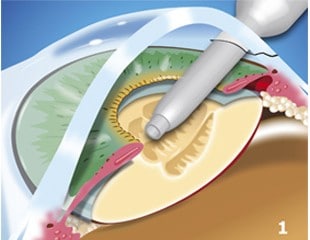
01
A small incision approx. 2mm to 3mm is made at the edge of the cornea. The cataract is broken into small pieces using a phacoemulsification probe.
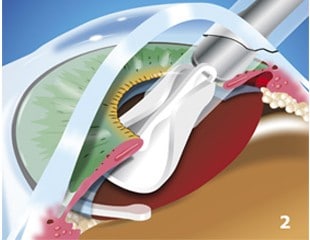
02
The fragmented cataract is removed from the eye by suction.
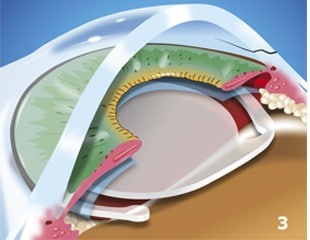
03
An intraocular lens (IOL) is implanted in the position previously occupied by the natural lens. The wound often seals on its own without stitches.
Cataract Specialist Care and Pre-Surgery Assessment
A cataract specialist assessment evaluates whether cataract surgery is suitable for your eyes and which intraocular lens will best fit your visual needs. The visit typically involves:
| 01. Vision and Refraction Testing | 02. Eye Pressure Measurement | 03. Slit Lamp Examination | 04. Retinal Assessment | 05. Biometry and Corneal Measurements |
| A measurement of your current vision and glasses prescription to gauge the cataract’s impact. | A reading of intraocular pressure to screen for glaucoma or other pressure-related conditions. | A detailed examination of the lens and front of the eye through a biomicroscope. | A check of the back of the eye, including the macula and retina, for conditions that may affect post-operative vision. | Specialist scans that measure the eye’s length and corneal curvature, used to calculate the appropriate IOL power. |
The cataract specialist also reviews your medical history, previous eye treatments, and visual goals. This evaluation identifies any co-existing eye conditions, such as glaucoma or macular disease, that may shape the surgical plan or affect expected outcomes.
The cataract pre-assessment typically takes between 60 and 90 minutes.
Dilating eye drops are used during the examination, so vision may remain blurred for several hours afterwards.
You are encouraged to bring a list of current medications and arrange for someone to accompany you home if you prefer not to travel alone after the visit.
4 simple steps to getting your Cataract Surgery

Schedule your eye examination and consultation with a cataract specialist at LSC Eye Clinic.


Discuss surgical options with the cataract specialist and confirm a surgery date.


Pre-surgery test measuring the eye’s length to calculate the appropriate IOL power.


Undergo cataract surgery, typically scheduled within 3 to 5 days* of consultation.

Selecting The Right Intraocular Lens For You
During cataract surgery, the clouded lens is replaced with an intraocular lens (IOL), which takes on the focusing role of the natural lens. Several IOL categories are available, and the appropriate choice depends on your eye health, prescription, and lifestyle priorities.
The main IOL categories and their typical trade-offs are:
| IOL Type | Vision Range | Potential Drawbacks |
| Monofocal | Single focal distance, usually distance | Glasses are typically required for reading and near work |
| Multifocal | Distance, intermediate, and near vision | Some patients notice halos or glare around lights, particularly at night |
| Toric | Corrects astigmatism alongside other distances | Requires precise lens alignment during surgery |
Recovery After Cataract Surgery
Most patients notice some improvement in vision within the first few days after cataract surgery in Singapore, with further stabilisation over the following weeks. Recovery experiences vary between individuals.
Common expectations during recovery include:
- Temporary blur or mistiness, typically lasting 2 to 3 days
- Mild discomfort or a foreign body sensation in the operated eye
- Use of prescribed eye drops over several weeks to support healing and reduce inflammation
- Follow-up visits at the clinic to monitor healing and visual recovery
Patients are advised to follow these general restrictions during the first few weeks of recovery:
- Avoiding eye rubbing
- Avoiding heavy lifting and strenuous exercise
- Avoiding swimming and direct water exposure to the eye
- Avoiding eye makeup until cleared at follow-up
- Avoiding dust-heavy environments where possible
The cataract specialist outlines the specific restrictions and recovery timeline relevant to your case at each follow-up visit.
Individual outcomes vary. Suitability and recovery experience are determined by clinical assessment.
Risks and Safety of Cataract Surgery
Cataract surgery is among the most commonly performed surgical procedures globally and is generally well tolerated. All surgical procedures carry some degree of risk. The potential risks specifically associated with cataract surgery include:
- Infection
- Inflammation
- Corneal or retinal swelling
- Changes in intraocular pressure
- Posterior capsule opacification (clouding of the lens capsule that can develop months or years later)
- Retinal detachment
- The need for additional procedures
At LSC Eye Clinic, risks are reviewed during the pre-operative assessment, and patients are monitored at scheduled follow-up visits to support healing and detect any post-operative concerns early.
Modern phacoemulsification techniques, careful pre-operative measurement, and structured post-operative care all contribute to the safety profile of cataract surgery in Singapore.
Why LSC Eye Clinic

|

|

|

|
| Appointment making is easy and fast | Subspecialty training in lens implant surgery | Conveniently located right at the heart of Orchard | Over 20 years of helping patients care for their eyes |
Frequently Asked Questions
*This information is not intended to replace consultation with your eye doctor.
Cataract surgery is one of the most commonly performed eye surgeries. As with any surgical procedure, potential risks include infection, inflammation, intraocular pressure changes, and the need for additional procedures. Your cataract specialist reviews the specific risks relevant to your eyes before surgery.
At LSC Eye Clinic, cataract surgery is performed one eye at a time. We typically schedule the second eye at least one to two weeks after the first, once the first eye has stabilised and is free of complications.
You should attend any pre-operative assessments scheduled at our eye clinic and follow the specific instructions given by your cataract specialist. Arrange for someone to accompany you home from the clinic after the procedure, as driving is not advised.
You may feel some coldness, brief light sensitivity, and quiet whirring sounds from the equipment. The procedure usually takes under 30 minutes per eye, and you remain awake throughout.
Your eye will feel tired and gritty for the rest of the day so we advise you to stay at home and rest as much as possible, and to avoid too much hand-held electronic devices o television. Your vision will be slightly misty for the first 2 – 3 days. It can take a few days for the eye to adjust and for vision to improve.
Previous LASIK alters corneal curvature, which can reduce the predictability of IOL power calculations during cataract surgery. Our cataract specialist accounts for this during pre-operative biometry, and we manage post-LASIK cataract cases as part of standard practice.
Payment Options
We Accept Cash, Nets, and Major Credit Cards:

Medisave
Cataract surgery and other eye procedures are Medisave claimable.
Our clinic is able to assist with your claim.
Most private insurance providers also cover cataract surgery claims.

Insurance
We are on the specialist panels of various Insurance Plans:

Meet Our Doctor

Dr Daphne Han
Medical Director and Senior Consultant
Ophthalmologist
MBBS (Melbourne), MMed (NUS), FRCS (Edinburgh), FAMS (Ophthalmology)
Subspecialty:
Laser Vision Correction and Lens Implant Surgery
Dr Daphne Han is the Medical Director and Senior Consultant Ophthalmologist at LSC Eye Clinic, with over 20 years of clinical experience in ophthalmology. Her subspecialty focus covers laser vision correction and lens implant surgery, encompassing LASIK, ZEISS SMILE® pro 2.0, ZEISS PRESBYOND®, Epi-LASIK, LASEK, PRK, and Implantable Collamer Lenses (ICL) for patients unsuitable for laser-based correction.
Dr Han trained at the Singapore National Eye Centre (SNEC), where she served for over 14 years, and has completed advanced fellowship training internationally, including at IROC Zurich under Professor Theo Seiler and at the Cincinnati Eye Institute. She holds an appointment as Adjunct Assistant Professor at Duke-NUS Medical School and remains active as a published author and peer reviewer in the field of refractive surgery.
In addition to refractive procedures, Dr Han performs conventional and laser-assisted cataract surgery and manages conditions including glaucoma and general ophthalmology, providing clinical oversight across a broad range of eye conditions.
Our Cataract Specialists are Experienced in
Complex and Post-Lasik Cataract Cases
Apart from the general cataract condition, there is also a wide range of unique and complicated cases such as post-traumatic, subluxed, posterior polar and phacomorphic cataracts.
Our cataract specialist at LSC Eye Clinic also manages complex and uncommon cataract cases that require additional surgical planning. These include:
– Post-traumatic cataracts (cataracts that develop after eye injury)
– Subluxed cataracts (where the lens is partially displaced from its normal position)
– Posterior polar cataracts (an opacity at the back surface of the lens)
– Phacomorphic cataracts (advanced cataracts dense enough to physically affect the eye’s drainage angle)
Cataract surgery in patients who have previously undergone LASIK requires additional consideration. The corneal reshaping from prior LASIK affects the accuracy of IOL power calculations, and adjustments are made during the pre-operative biometry to account for this curvature change.