
眼科:展望光明
In the past 2 years, many eye care professionals (such as myself) have found themselves being periodically freer than usual. It is understandable that when hospitals came under pressure for infectious diseases management and ICU beds, eye treatments and surgeries, the majority of which are elective, were relegated to the back burner for a while, to conserve resources.
Eye clinic attendance has normalised by last year, after clearing a large backlog from the bottleneck created at the height of the pandemic. However, months of sociallydistanced, webbased learning and work behaviour threaten to leave behind “epidemics” of childhood myopia and computer vision syndrome.
While schoolbased sports and physical activities are back to full swing, it seems some aspects of adult behaviours, such as in-retail experiences, may never return to what it was pre-pandemic.
Perhaps when the pandemic truly subsides, we should all make a point to ditch the electronic devices and return to shopping at brick and mortar stores, for the sake of supporting the industry, but perchance also to improve our fitness and rest our eyes. While the pandemic rages on, hopefully to an imminent end, life and technology continue to advance in many realms.
In my speciality of ophthalmology, telemedicine and artificial intelligence became growth areas, with roles to play permanently. New eye treatments such as injections for macula diseases, and devices like lens and glaucoma drainage implants manufactured internationally were introduced locally. Although there have been frequent significant delays, innovations have continued unabated, including in my clinic
In the field of cataract surgery, the age-old categorisation of implants into two distinct groups – either monofocal or multifocal – remains the same. However, each category has seen new developments in the introduction of improved lens designs.
This has provided more choices for patients and surgeons alike, in making cataract surgery an even more effective sight-perfecting procedure than it already was, so much so that it is quite possible to restore an elderly person’s vision to that of a youngster.
The debate regarding femtolaser– assisted versus manual phacoemulsification versions of cataract surgery saw some conclusions made by observation of hard facts.
There are far fewer laser cataract surgeries being performed in most operating theatres here compared to prior years, despite an increasing number of cataract surgeries as a whole. Regardless of this fact, my personal experience is that laser-assisted cataract surgery still has its benefits, in surgical uniformity and potential ability to minimise collateral damage especially in some unique cases.
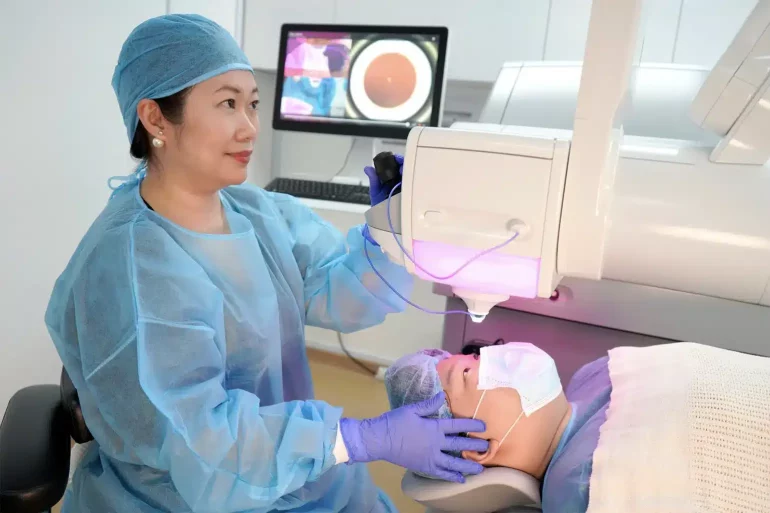
Cost and logistics are limitations, which could be overcome in some ways, such as with the use of the highly versatile Ziemer Z8 laser, whose nifty mobility makes it the only laser supportive of a cataract surgery experience without having to move the patient or the surgery bed after commencing the case, improving patient comfort.
Eye doctors overseas found themselves wondering about offering cataract surgeries on both eyes of the patient at the same session to reduce clinic visits. It seems to be a rather apt proposal for improved efficiency particularly when the pandemic was serious.
Interestingly, the main resistance to this becoming a widespread practice stems also from the point of infection control. There is an approximately 0.01 per cent risk of infection in the eye arising from cataract operation, which, according to some studies, may be further reduced by preventive injection of antibiotics during the surgery.
To inject antibiotics or not at the point of cataract operations is similarly a question that still sees no end of debate within the community of eye surgeons worldwide.
With an emphasis of providing individualised care in my clinic, my approach is to discuss both sides of these issues with my patients, laying out all options available, including laser cataract on both eyes simultaneously. The latter had benefitted quite a few timestrapped patients and those who prefer not to visit the hospital too much. The smooth workflow for this last option is made feasible only with a mobile laser system like the Ziemer Z8.
In the field of laser vision correction, the still popular Lasik (laser in-situ keratomileusis) continues to be dominant. It too has evolved to become safer and more stable with more common use of protective measures like crosslinking. Finer measurements and their attendant customised or wavefront Lasik treatments, such as the iLasik which I am partial to, aim to improve the quality of eyesight.
In fact, these potentially more precise wavefront Lasik treatments can and have been put to good use to restore vision in some cases who suffered side effects and imperfect results from previous cataract surgeries involving multifocal implants. So it may still be possible to give that fancy lens implant a chance with a touch of Lasik.
One of the highlights in my clinic in the past months has been the introduction of the new eye laser treatment called Clear for the correction of myopia/short-sightedness and astigmatism.
A laser vision correction involving the removal of a thin layer of laser-created corneal “lenticule”, it is an alternative to Lasik and is similar to the 10-year-old Relex Smile, with the advantage of improved customisation.
It represents the first of the second wave of lenticule extraction lasers to reach our shores commercially, a testament to Ziemer’s highly sophisticated and adaptable femtolaser systems, and an affirmation that the lenticule technology is here to stay alongside Lasik.
We are delighted to complete our range of laser vision treatment offerings with this newest addition, and are confident of the role Clear can play in our wide range of eye surgery options.
Lastly, speaking as a die-hard optimist, even as Covid-19 continues its assault daily, if we so choose to look, there will be light at the end of this long tunnel. And rest assured that in the field of specialist eye care, not even Covid-19 can stop our spirit to make the world see brighter.
The article was contributed by Dr Daphne Han and first published on The Business Times.
LSC眼科诊所为患有急症且需要立即就医的患者提供急诊服务。请立即致电预约,保护您的视力!
About the Author
达芙妮·韩医生
医疗总监兼高级 眼科顾问 医师
医学学士(墨尔本大学),医学硕士(新加坡国立大学),爱丁堡皇家外科学院院士(FRCS),澳大利亚医学会眼科院士(FAMS)
专长:激光视力矫正和晶体植入手术
达芙妮·韩医生是位于帕拉贡的LSC眼科诊所的医疗总监兼高级眼科顾问医师。她拥有超过20年的临床经验,在多种激光视力矫正手术方面技艺精湛,包括蔡司SMILE®pro 2.0、LASIK、 LASIK Xtra、先进表面消融术以及植入式隐形眼镜(ICL)等。
韩医生此前曾任新加坡国家眼科中心(SNEC)白内障与综合眼科及激光视力中心的眼科顾问医师,以及杜克-新加坡国立大学医学院的兼职助理教授。她曾担任白内障手术和LASIK手术的培训导师,负责指导其他医生。 她曾在科学期刊和教科书上发表文章,是各类会议的特邀演讲嘉宾,并担任专业期刊的考官和审稿人。她此前还曾担任SMG视力中心、格伦伊格尔斯医院和新加坡专科医疗中心的主治眼科医生。
韩医生接诊过不少就医过晚的患者,因此她深信,良好的视力是人生最宝贵的财富之一。她以循证医学为指导,结合整体治疗理念和知情选择,竭尽全力帮助患者保持视力并发挥其最大潜能。
预约

WhatsApp:+65 9843 1000
仅限一般咨询和预约
电子邮件:[email protected]
周一至周五:上午9点至下午6点
周六:上午9点至下午4点
*最后登记时间下午2点
周日及公共假期:休息
Comment (1)
请在此留下您的想法
您必须登录后才能发表评论。

top up termurah
I know this if off topic but I’m looking into starting my own weblog and was curious what all is required to get setup? I’m assuming having a blog like yours would cost a pretty penny? I’m not very internet smart so I’m not 100 certain. Any suggestions or advice would be greatly appreciated. Cheers