激光视力矫正,生活方式

关于幼童弱视,您可能不知道的几件事

关于幼童弱视,您可能不知道的几件事

One of the nursery books and videos I remember sharing with my first-born was by the American author and illustrator Richard Scarry, and the theme song lyric that goes “you can be anything you want to be…” That was before the introduction of the iPhones and iPads.

So much of a child’s growth is dependent on good vision in the past two decades with the proliferation of the use of digital devices. One of the most important gifts you can give your child is…not an iPad, but to ensure that his or her eyes develop fully and not become a lazy eye, which in scientific parlance, is called amblyopia. This will definitely help in allowing them freedom in pursuing their dreams and ambitions in live.

To start with, children undergo maturation of their visual system and the process is pretty much complete by the time they turn eight. Should there be any disturbance of this process of maturation such as from eye conditions like squint (misalignment where the eyes seem to be looking at different directions), refractive errors like high long-sightedness or astigmatism, childhood cataract or droopy eyelid, the equal process of maturation between the eyes can be derailed due to the phenomenon of inter-eye rivalry, where the better eye takes it all and the poorer eye fails to mature fully. Yes, even in the “world” of eye development, Darwinism seems to be at work where survival goes to the fittest.

The truth is most of us are born with two eyes that are meant to see things from a slightly different angle. This slightly different perspective between the two eyes serves the purpose of giving us binocular, stereoscopic vision i.e. 3-D vision through which we perceive depth and distance. A single eye can find clues regarding depth and distance from size and shadows, but this may not be sufficient for some activities that require good depth judgement, for example, intricate horological work or performing life-saving surgery. Stereoacuity or 3-D vision is assessed by eye tests such as Titmus or Worth 4 dots tests which are done at specialist eye clinics.

children lazy eyes

They can be categorised into gross or fine stereoacuity. Gross stereoacuity is usually sufficient for most activities of daily living while fine stereoacuity is often advisable for tasks involving more demanding hand-eye coordination.

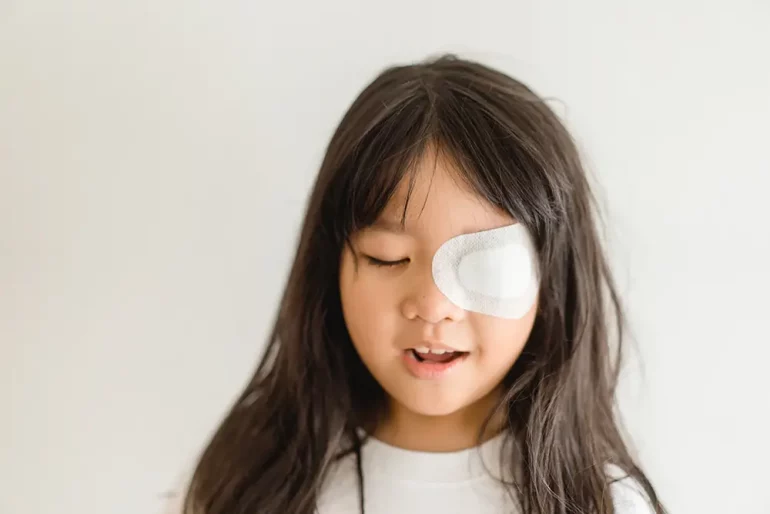
For higher grade steroacuity to develop, both eyes need to be matured fully and be able to see sharply. The time window for this is usually limited to the first eight years of our lives with the earlier years being more crucial than the latter years. For kids who unfortunately suffer from eye conditions like squint or astigmatism, especially when the severity of these conditions is not symmetrical in the two eyes, it is imperative that not only are their primary eye conditions get managed and treated but the development of their more seriously affected eye needs to also be safeguarded by penalizing the better eye. Which is why you may have sometimes seen kids patching their eyes, and the commonest scenario would be kids patching their straight eyes as a treatment to prevent lazy eye from happening in the drifting eye that is prone to becoming a lazy eye.

Apart from a drifting squint eye which is most commonly an outward- drift followed by -drift, and astigmatism, other worrying eye conditions that may result in lazy eye include refractive errors like high degrees of long-sightedness which often compound an inward drifting eye. These relatively common reasons are why in Singapore, health services have in place school-based eye checks from as early as 2 years of age to identify at risk children and recommend further management should significant reduction of eyesight be found.

Other less common childhood eye conditions that may cause a lazy eye include eye diseases affecting premature children such as retinopathy of prematurity, childhood cataract, droopy eyelids and actually, anything that may occlude and obscure the eye’s line of sight, including overly long bangs covering the eyes over long duration of time, which is one very valid reason to keep young kids’ hair well away from their faces.

Should there be mild amblyopia, computer-based vision training (such as a program called Vivid vision) may have a role. Speak to us to find out more.

About the Author

达芙妮·韩医生

医疗总监兼高级 眼科顾问 医师 医学学士(墨尔本大学),医学硕士(新加坡国立大学),爱丁堡皇家外科学院院士(FRCS),澳大利亚医学会眼科院士(FAMS)

专长:激光视力矫正和晶体植入手术

达芙妮·韩医生是位于帕拉贡的LSC眼科诊所的医疗总监兼高级眼科顾问医师。她拥有超过20年的临床经验,在多种激光视力矫正手术方面技艺精湛,包括蔡司SMILE®pro 2.0LASIK、 LASIK Xtra先进表面消融术以及植入式隐形眼镜(ICL)等。

韩医生此前曾任新加坡国家眼科中心(SNEC)白内障与综合眼科及激光视力中心的眼科顾问医师,以及杜克-新加坡国立大学医学院的兼职助理教授。她曾担任白内障手术和LASIK手术的培训导师,负责指导其他医生。 她曾在科学期刊和教科书上发表文章,是各类会议的特邀演讲嘉宾,并担任专业期刊的考官和审稿人。她此前还曾担任SMG视力中心、格伦伊格尔斯医院和新加坡专科医疗中心的主治眼科医生。

韩医生接诊过不少就医过晚的患者,因此她深信,良好的视力是人生最宝贵的财富之一。她以循证医学为指导,结合整体治疗理念和知情选择,竭尽全力帮助患者保持视力并发挥其最大潜能。

预约

    本网站受reCAPTCHA保护,并适用Google的隐私政策服务条款


    电话:+65 6836 1000

    WhatsApp:+65 9843 1000
    仅限一般咨询和预约

    电子邮件:[email protected]

    周一至周五:上午9点至下午6点
    周六:上午9点至下午4点
    *最后登记时间下午2点
    周日及公共假期:休息

    请在此留下您的想法

    电话图标 致电我们 WhatsApp 日历图标 预约