
Fault Signs of Lao Hua (Presbyopia): 7 Moments Pickleball Players Over 40 Will Recognise
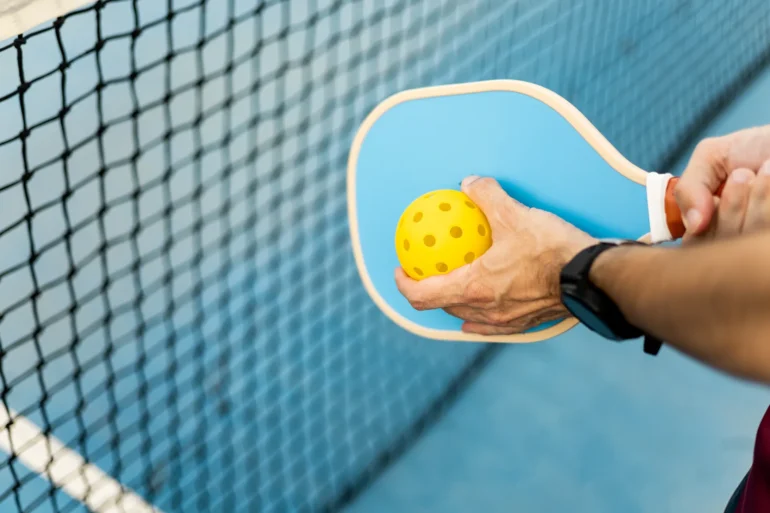
Pickleball has taken over. Courts are booked out weeks in advance, the group chats never stop buzzing, and you’ve finally found a sport your knees can keep up with.
But somewhere between the serve and the score, something has been quietly getting in the way of your game. It’s not your opponent’s dinks.
It’s your eyes.
If you’re over 40, there’s a good chance your eyes have been sending you signals for a while now. Signals that are easy to brush off as tiredness, bad court lighting, or “I just need a stronger phone brightness.”
We call these the fault signs of lao hua (presbyopia). If you recognise more than a couple of the moments below, your eyes may be trying to tell you something worth listening to.
First, what exactly is Lao Hua, and why does it happen after 40?
Lao hua (老花) is the Mandarin term for presbyopia, also known as rabun tua in Malay/Indonesian. In plain English, it simply means age-related long-sightedness.
Here’s what happens: the natural lens inside your eye gradually loses its flexibility as you age. When you’re young, that lens adjusts instantly, from near to far and back again, without you thinking about it. After 40, it stiffens. Switching focus from your paddle to the scoreboard and back starts to take effort. Things up close become blurry or strained.
It is completely normal. It happens to almost everyone. And this is the part most people don’t know: it can now be treated with a laser vision procedure called PRESBYOND.
But before we get to that, let’s talk pickleball.
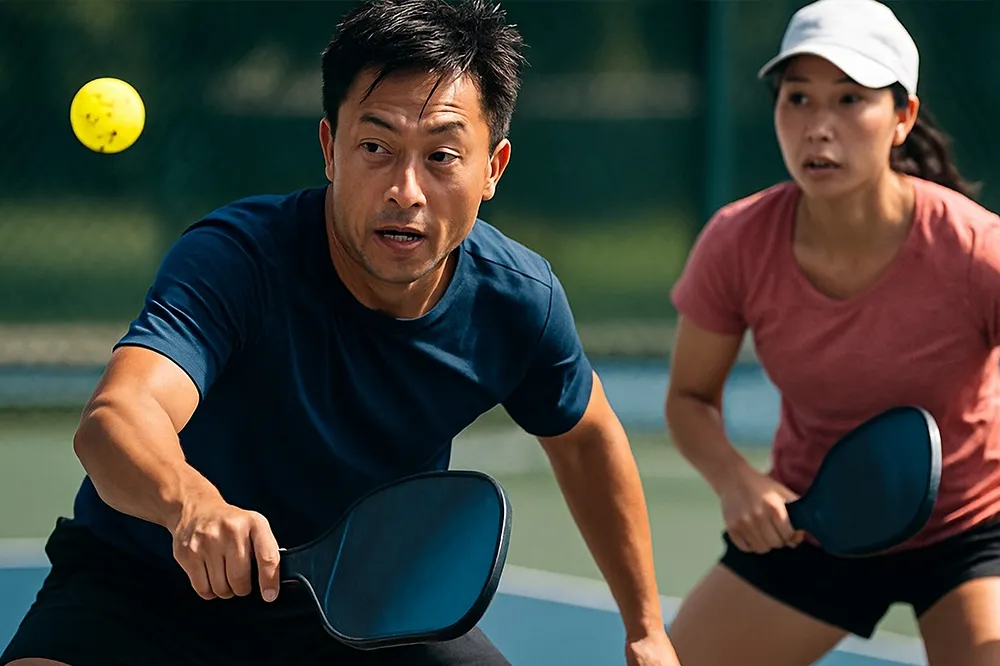
7 Fault Moments Pickleball Players Over 40 Will Recognise
- You have to ask “what’s the score again?” more than you’d like to admit
You know that moment before serving when you’re supposed to call out the score: server, receiver, then serve number? You used to rattle it off without thinking. Now you find yourself pausing, double-checking the scoreboard clipped to the fence, or asking your partner to confirm.
Squinting to read small numbers at normal distance is one of the earliest signs of presbyopia.
- Your phone is always at arm’s length when you’re checking the court booking app
You’re trying to lock in a court for Saturday morning before the good slots disappear. Without thinking, your arm extends outward, further than it used to, until the booking screen comes into focus.
Sound familiar?
This instinctive “long arm” move is the classic presbyopia tell. Your eye can no longer pull close text into focus, so your arm does the work instead.
- Reading the group chat between games gives you a headache
Your pickleball kaki WhatsApp group is going absolutely wild. Court updates, paddle recommendations, memes about someone’s dink game.
But keeping up with the chat while glancing back at the court is leaving your eyes tired and your head throbbing.
Eye strain and headaches from switching between near and far focus, especially between rallies, are a very common presbyopia symptom that most people blame on stress or sun.
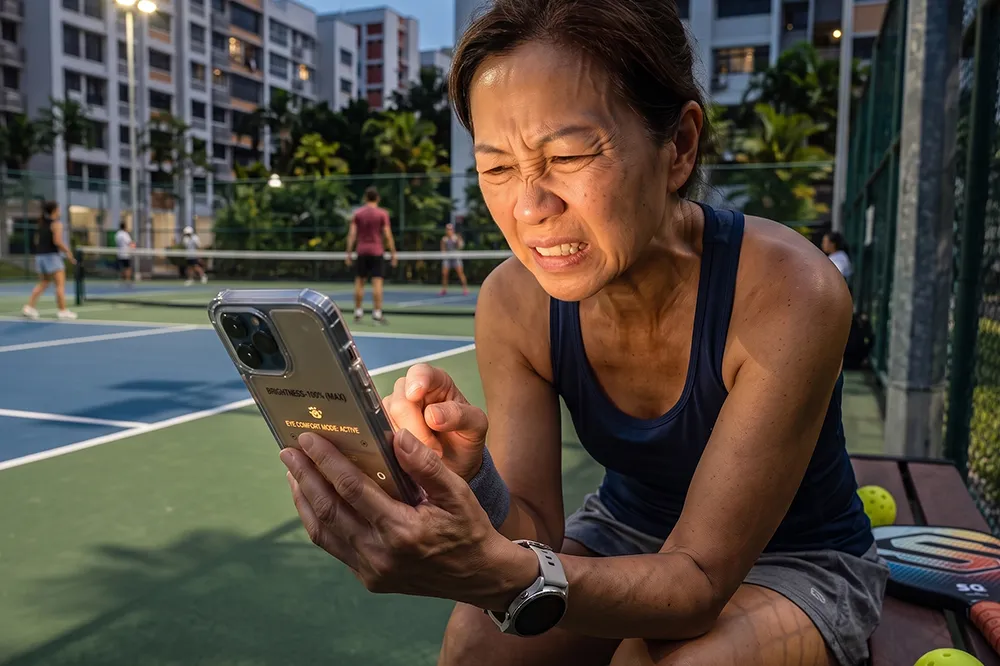
- You’ve turned your phone brightness up to maximum, and it still doesn’t help
More brightness feels like it should help, especially out on a sunny court. It doesn’t. Because the issue isn’t how bright the screen is. It’s that your lens can no longer bring close-up text into sharp focus, no matter how much you adjust the settings.
If you’ve already maxed out your brightness and font size and things still aren’t crisp, that’s your eyes talking.
- You hold the paddle box, or the mamak menu after the game, at arm’s length to read it
Whether it’s the spec sheet on a new paddle you’re eyeing, the menu at your regular post-game mamak stop, or the QR code description that pops up on your phone, you’ve started holding things further away than everyone else at the table.
This is so common among people in their 40s and 50s that it has become a bit of a joke. But it doesn’t have to be a permanent one.

- Evening games under the court lights are harder on your eyes than morning sessions
There’s something about playing under floodlights: lower ambient light, glare off the ball, small on-screen text on the score app, that leaves your eyes more fatigued than a daytime session.
You’re more likely to lose track of the ball’s spin, miscall a line, or find everything slightly harder to process.
Low-light environments make presbyopia symptoms noticeably worse, which is why many people first notice the issue during evening play.
- You’ve quietly started wearing reading glasses, but left them at home again
You got the glasses. They help. But they’re on the kitchen counter, or in the car, or in the bottom of your paddle bag.
Presbyopia reading glasses have a way of being everywhere except where you need them.
You’ve squinted through more than one scoreboard rather than go and get them. And deep down, you know this is becoming a pattern.
So what can you actually do about it?
Here is where we want to share something that most people over 40 don’t know yet.
Presbyopia is not just something you have to live with.
Most people know about LASIK for short-sightedness (myopia). Far fewer people know that there is now a laser vision treatment designed specifically for presbyopia, and it’s called ZEISS PRESBYOND Laser Blended Vision.

What is PRESBYOND?
PRESBYOND is a laser eye treatment developed by ZEISS that is designed to address presbyopia, the age-related blurring of near vision that affects most people over 40.
Unlike reading glasses or bifocals, PRESBYOND works by using laser technology to adjust each eye slightly differently, creating what is called a “blended zone,” a range of vision that allows most patients to see clearly at near, intermediate, and far distances, all without glasses. It is a different approach from standard myopia LASIK, designed specifically for the visual needs of people in their 40s and 50s.
Why pickleball players over 40 are paying attention to PRESBYOND
Think about what your eyes actually have to do in a single point. Read the score. Track a fast ball at distance. Glance at your partner. Check the line. Refocus on the next serve. That’s near, far, near, far, all in the space of a few seconds. It’s exactly the kind of switching that gets harder once presbyopia sets in.
Reading glasses can help you read the menu. They don’t help mid-rally. You can’t exactly pause to put them on before returning a dink. This is one of the main reasons PRESBYOND has become appealing to people who are active, social, and simply don’t want an eyewear routine dictating how they play, travel, or live.
A few reasons people are choosing to look into it:
- No more accessories. No more patting down your bag for reading glasses before every match, no lens-cleaning mid-game, no glasses fogging up under the floodlights.
- All-distance vision. Most patients can transition from reading the scoreboard to tracking the ball to checking their phone without switching glasses or squinting.
- Quick procedure. The procedure itself is typically done within minutes per eye, with many patients returning to normal activities within a day or two (your eye doctor will confirm the exact recovery timeline for your case).
- Treats the cause. Reading glasses compensate for the problem every time you put them on. PRESBYOND is designed to treat the underlying focusing issue itself.
- Peace of Mind. For a lot of people, the biggest win isn’t just the vision, it’s not having to plan around it anymore. No more “wait, where are my glasses” during a tournament, no more missed line calls because you couldn’t see clearly.
If you’ve ever thought “I’ll just deal with it” every time you squint at a scoreboard, it’s worth asking yourself: how many more seasons do you want to deal with it?
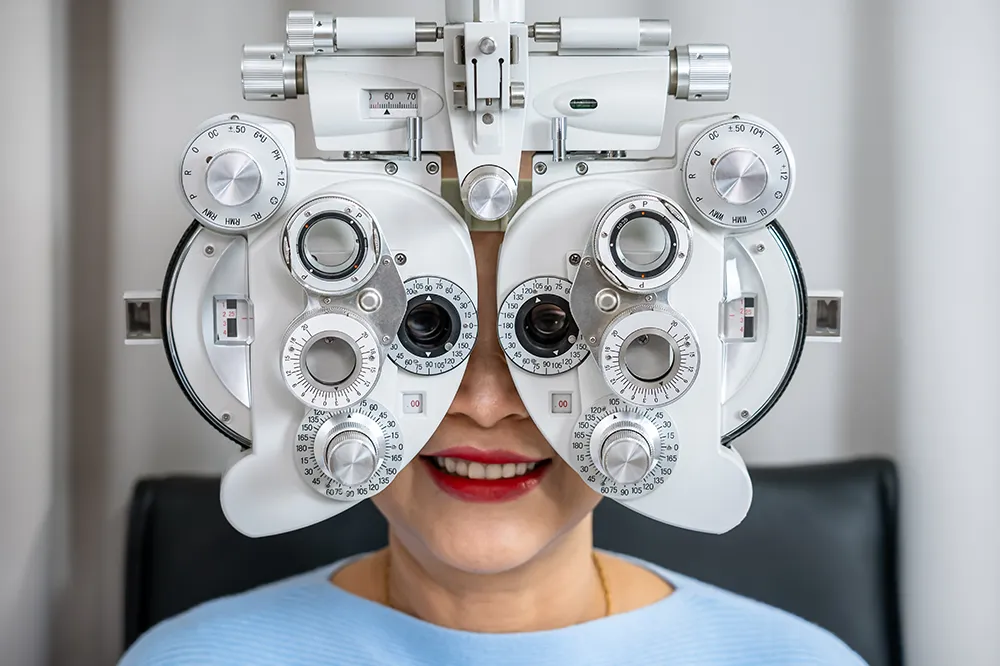
Is PRESBYOND right for you?
PRESBYOND is not suitable for everyone, and only a proper eye assessment can determine whether you are a candidate. Suitability depends on factors like your current prescription, the health of your corneas, and your overall eye condition.
What we’d encourage you to do, especially if you recognised yourself in more than two or three of the moments above, is book a consultation with your eye care professional and ask about PRESBYOND specifically.
Many people who could benefit from PRESBYOND simply don’t know it exists. They carry their reading glasses around, squint through scoreboards, and assume this is just what getting older means for their eyes.
It doesn’t have to be.
The Final Point
Pickleball season isn’t slowing down anytime soon. The rallies, the community, the post-game mamak sessions: you want to enjoy all of it in full clarity, not through squinted eyes and a pair of glasses you can never find.
Every season you play with blurry near vision is a season you’re compensating instead of just playing. The good news is that this is one of the few age-related changes you actually have a real option for. Not a workaround. An actual treatment.
If your eyes have been calling faults on you, don’t just wait for the next reading-glasses moment to remind you. Book a consultation with your eye doctor and ask specifically about PRESBYOND. Find out if you’re a candidate, understand what the procedure would involve for your eyes, and make an informed decision from there.
The best time to ask was before you started missing line calls. The next best time is now.
This article is for general informational purposes only and does not constitute medical advice. Please consult Dr Daphne Han @ LSC Eye Clinic for a personalised assessment.
Similar Articles